
Ornamental Iron Fencing for Plano's Front Yards, HOA Communities, and Property Lines
Powder-coated ornamental iron fence installation for Plano homeowners and commercial properties, with a free on-site estimate before any commitment.
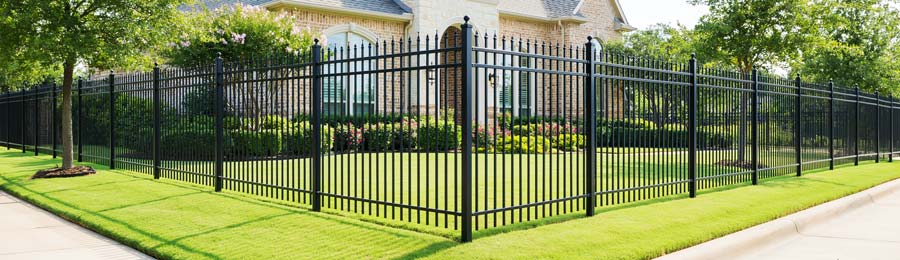
The Fence Plano's Deed Restrictions Put in the Front Yard
In many of Plano’s HOA communities, the material conversation for front yard and street-facing fencing is settled before a homeowner ever calls for an estimate. Where cedar privacy fencing governs the rear yard, ornamental iron — or aluminum built to the same specification — is what the covenant specifies for visible perimeter fencing. It is the material that reads as intentional from the street, that holds its appearance across decades without staining or sealing, and that satisfies the aesthetic standards written into Plano’s most established deed-restricted neighborhoods.
The result in Plano is a two-material household that is more common here than in most DFW markets: cedar board-on-board running the rear yard line, ornamental iron defining the front and side street exposure. Both installed to HOA specification. Both built to last in North Texas conditions.
What Plano's HOA Covenants Mean When They Say Ornamental Iron
Ornamental Iron in Plano: Materials, Specifications, and What the HOA Actually Requires
What “Wrought Iron” Means in 2026
The term wrought iron is used across the fence industry — and across Plano’s HOA covenant documents — to describe a material that is almost never true wrought iron anymore. Modern ornamental fencing is fabricated from mild steel or tubular steel with a galvanized coating and a powder-coat finish applied over the top. This is not a downgrade from historical wrought iron — it is a more consistent, more rust-resistant product that holds a powder-coat finish better than hand-worked iron ever did. When a Plano HOA covenant specifies wrought iron fencing, it means ornamental iron or steel fencing built to that aesthetic standard. When you are comparing bids from different contractors and one says wrought iron and another says ornamental steel, they are describing the same product category. What varies is the steel gauge, the powder-coat quality, and the fabrication precision — which is where the real differences in price and longevity come from.
Iron vs. Aluminum: What Plano HOAs Specify and Why It Matters
Some of Plano’s newer HOA communities have updated their covenant language to specify aluminum rather than steel as the approved ornamental fencing material. Aluminum does not rust under any conditions — the oxidation resistance is a property of the base metal, not a coating applied over it — which makes it a lower-maintenance option in markets with significant moisture exposure. For most of Plano’s established neighborhoods, steel with a quality powder-coat finish performs well and is the more widely available option. The distinction matters specifically for HOA compliance: if your covenant names the material, the fence needs to match it. We review covenant language as part of every estimate and specify the correct material before fabrication begins.
Panel Styles and Heights
Standard ornamental iron panels in Plano’s residential market run in three primary profiles: flat top, which presents a clean horizontal line appropriate for most HOA front yard applications; spear top, which adds a traditional pointed finial at each picket and is common in Plano’s older established neighborhoods; and decorative scroll, which incorporates scrollwork between pickets for a more formal appearance. Panel heights for residential front yard fencing typically run three to four feet in Plano’s HOA communities, with taller panels used for side yard transitions and commercial perimeter applications. We fabricate to the height your covenant specifies — not to a stock panel size that approximates it.
Powder Coat Finish and Long-Term Maintenance
A quality powder-coat finish on ornamental steel fencing does not require annual maintenance. The finish should be inspected annually for chips or scratches — particularly at weld points and cut edges where the base steel is most exposed — and touched up promptly with a rust-inhibiting primer before the oxidation spreads. A fence that is touched up at the first sign of coating damage will outlast one that is left until rust is visible by a decade or more. In Plano’s climate, the primary threat to powder-coat finishes is not moisture but UV exposure and the physical impact of lawn equipment during the mowing season. Black and dark bronze finishes are the most common choices in Plano’s neighborhoods and the most forgiving in terms of showing UV fade over time.
Common Questions About Wrought Iron Fence Installation in Plano
Does my Plano HOA require ornamental iron or will aluminum satisfy the covenant?
It depends on the specific language in your covenant. Plano’s older established neighborhoods typically specify wrought iron or ornamental iron, which in practice means steel fabricated to that aesthetic standard. Some of Plano’s newer HOA communities have updated their language to specify aluminum, which is rust-proof at the material level rather than relying on a protective coating. If your covenant names a material, the fence needs to match it — a steel fence installed in an aluminum-specified community, or vice versa, creates a compliance issue regardless of how similar they look. We pull and review your covenant language before every estimate so the material we specify satisfies the requirement.
What is the difference between wrought iron, ornamental steel, and aluminum fencing?
True wrought iron — hand-worked iron with a fibrous internal structure — is rarely used in modern fence manufacturing. What the industry and most HOA documents call wrought iron fencing is fabricated from mild or tubular steel with a galvanized layer and powder-coat finish. Ornamental steel and wrought iron are the same product category described with different terminology. Aluminum is a separate material entirely — lighter than steel, rust-proof without any coating, and slightly less rigid at equivalent gauge. For most Plano residential applications the visual result is nearly identical. The differences that matter are rust resistance over time, HOA specification compliance, and cost — aluminum typically runs higher per linear foot than powder-coated steel.
How long does an ornamental iron fence last in North Texas?
A properly installed ornamental steel fence with a quality powder-coat finish will last 20 to 30 years in North Texas conditions with basic maintenance — meaning prompt touch-up of any chips or scratches to prevent rust from spreading at the base metal. The primary failure modes are coating damage from lawn equipment impact and weld-point corrosion where the finish is thinnest. Aluminum fencing does not rust regardless of coating condition and will outlast steel in high-moisture environments. Both materials significantly outlast wood fencing in terms of structural integrity, though they serve different aesthetic purposes and HOA requirements in Plano’s neighborhoods.
What fence heights are standard for ornamental iron in Plano HOA communities?
Front yard and street-facing ornamental iron fencing in Plano’s residential HOA communities typically runs three to four feet in height — enough to define a property boundary clearly without obstructing sightlines. Side yard transitions from iron to cedar privacy fencing often step up to five or six feet at the rear yard line. Some Plano HOAs specify the height explicitly in the covenant; others defer to the City of Plano’s zoning code, which limits front yard fences to four feet in most residential districts. We review both the HOA requirement and the city ordinance before finalizing any height specification.
Can ornamental iron fencing be added to an existing cedar fence installation?
Yes — the two-material perimeter is one of the most common configurations in Plano’s HOA communities. Cedar board-on-board runs the rear yard line for privacy; ornamental iron defines the front yard and street-facing exposure where the HOA requires an open aesthetic. The transition between materials typically occurs at the side yard gate, which can be fabricated in either material or as a combination frame. We install both materials and handle the full perimeter as a single project when the scope includes both — which avoids the coordination and site access issues that come with using separate contractors for each material.
How much does ornamental iron fence installation cost in Plano?
Ornamental iron fence installation in Plano typically runs $25 to $45 per linear foot installed for standard residential panel styles — flat top and spear top in three to four foot heights. Decorative scroll panels and taller commercial-grade sections run toward the higher end of that range. A standard 80-linear-foot front yard installation runs roughly $2,000 to $3,600 depending on panel style, post spacing, and gate count. Gate openings add cost depending on width and whether automation is included. Every estimate is free, based on a real look at the property, and covers both the material specification and the permit requirements before any number is committed.