
Fence Staining for Plano's Cedar Fences — Including the Ones That Came Pre-Stained
Professional staining and sealing that extends the life of Plano wood fences, addresses HOA appearance requirements, and picks up where factory stains leave off.
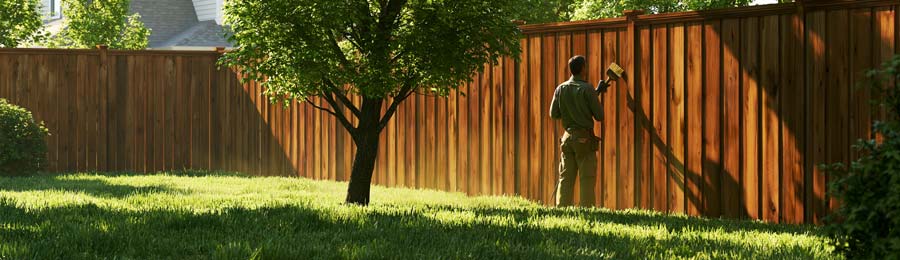
The Question Plano Homeowners Ask About Pre-Stained Cedar
A significant number of Plano’s cedar fences were installed with pre-stained lumber — boards that arrived from the mill with a factory-applied stain already on the surface. Several of the region’s most active fence companies have made pre-stained cedar a primary selling point, and for good reason: a pre-stained fence looks finished from the first day and provides a head start on UV and moisture protection.
What those fences eventually need — and what no factory stain prevents indefinitely — is re-staining. The factory stain on pre-stained cedar typically provides meaningful protection for three to five years under North Texas conditions, after which the same UV exposure, moisture cycling, and temperature swings that affect any cedar fence begin degrading the surface. The fence that arrived looking finished will eventually start graying at the same rate as any unstained cedar if it is not re-stained on schedule.
The re-staining process for pre-stained cedar requires assessment before application. If the original factory stain has worn unevenly — which is common on south and west-facing fence sections that take the most direct UV exposure — new stain applied over a partially degraded surface will not produce even coverage. Prep work, which may include cleaning, light sanding of degraded sections, and in some cases a stripping step for factory stains that have peeled rather than worn, is what determines whether the re-stain job lasts. We assess the current stain condition on every estimate before recommending a prep and application approach.
Staining and the Full Fence Assessment
Plano has dedicated staining companies that do excellent work on the staining itself. What a full-service fence company provides that a staining specialist cannot is a structural assessment alongside the staining work. A fence that is ready for re-staining is also a fence whose posts, rails, and hardware are worth inspecting at the same time. Fence repair identified during a staining visit — a post that has started to lean, a rail that has cracked, a gate hinge that is pulling from the frame — is far less expensive to address while the crew is already on-site than it is to schedule as a separate repair call after the staining is complete.
Staining as an HOA Compliance Measure in Plano's Deed-Restricted Communities
HOA Appearance Standards, Color Selection, and the Plano Staining Window
When a Gray Fence Becomes an HOA Issue
In Plano’s deed-restricted communities, fence maintenance standards frequently include appearance requirements that go beyond structural integrity. A fence that has gone gray, is visibly checking or splitting, or shows surface deterioration that is apparent from the street or a neighboring property can generate an HOA violation notice even when the fence is structurally sound. Staining is the remedy — and in HOA violation situations, the timeline for the remedy is not flexible.
We handle HOA appearance compliance staining with the same urgency as structural repair calls and provide written documentation of completed staining work for HOA review submission. If the violation notice specifies a color standard — some Plano HOAs specify a particular stain tone to maintain visual consistency across shared fence lines — we match to that standard before any stain is purchased.
Color Selection in Plano’s Market
The color question for cedar fence staining in Plano’s neighborhoods runs predominantly toward warm natural tones — cedar brown, redwood, and medium walnut cover the majority of Plano’s residential staining work. Darker tones have been trending in the market’s newer communities along the northern tollway corridors, where horizontal cedar fencing and darker stain choices read as a modern aesthetic against the lighter exterior palettes common in that construction era. Gray and driftwood tones are available for homeowners whose HOA does not specify a color and who prefer a cooler palette, though gray stains in North Texas’s UV environment require the same re-application schedule as warmer tones — the pigment that provides UV protection is in the stain regardless of the color selected.
Oil-Based vs. Water-Based Stains for North Texas Conditions
Oil-based penetrating stains are the preferred specification for cedar fence staining in Plano’s climate. They penetrate the wood grain rather than sitting on the surface, which means they protect from within rather than from a surface film that can peel or crack under UV stress. Water-based stains have improved significantly and are appropriate in some applications, but oil-based products remain the more durable choice for exterior wood exposed to North Texas’s full UV load and temperature range.
Solid stains — which fully obscure the wood grain — provide strong color coverage but behave more like paint than penetrating stain in terms of how they age. They can peel rather than wear, which creates more prep work at the re-staining stage. Semi-transparent and transparent stains allow the wood grain to show and wear more naturally. For most Plano residential cedar fences, a semi-transparent oil-based stain in a warm natural tone is the specification that performs best across a full re-staining cycle.
The Plano Staining Window
The best time to stain a cedar fence in Plano is spring — March through May — or early fall — September through October — when temperatures are consistently between 50 and 90 degrees and the UV index is not at its summer peak. Stain applied in direct summer sun when temperatures exceed 95 degrees dries too quickly to penetrate properly, which shortens the protection window.
The fence surface must be dry before staining — 24 to 48 hours without rain is the minimum. New cedar, as covered on the wood fence installation page, needs 30 to 60 days to cure before staining regardless of season. For existing fences being re-stained, a pressure wash to remove dirt, mildew, and surface degradation followed by adequate drying time is the prep step that most do-it-yourself staining attempts skip — and the most common reason a stain job fails ahead of schedule.
Common Questions About Fence Staining in Plano
My fence came pre-stained from the installer. Does it still need to be re-stained?
Yes. Pre-stained cedar arrives with a factory-applied stain that provides a head start on UV and moisture protection, but it does not eliminate the need for re-staining as the wood cures and the fence ages. Under North Texas conditions, a pre-stained cedar fence typically needs re-staining within three to five years of installation. South and west-facing sections — which take the most direct UV exposure — often show wear sooner than sections in shade or on north-facing exposures. The re-staining process for pre-stained cedar requires a condition assessment first: if the factory stain has worn unevenly or begun to peel, prep work is needed before new stain is applied.
Can a gray, weathered fence be restored with staining or does it need to be replaced?
A fence that has gone gray is not necessarily a fence that needs to be replaced. Graying is a surface condition — UV exposure breaks down the lignin in the cedar surface, which produces the gray color — but it does not indicate structural failure. If the posts are sound and the boards are not rotted or checking deeply, a properly prepped and stained gray fence can be restored to a significantly improved appearance and have its service life extended by years. The prep work is the critical step: cleaning, possibly light sanding or brightening treatment, and adequate drying time before stain is applied. A fence with deep checking, significant board rot, or failed posts needs repair or replacement before staining makes sense — stain does not address structural problems.
My HOA cited me for fence appearance. Can staining fix the violation?
In most cases, yes. Plano HOA appearance violations related to fences typically cite graying, surface deterioration, or a fence that no longer meets the community’s maintenance standard. Professional staining addresses all of those conditions when the fence is structurally sound. We provide written documentation of completed staining work suitable for HOA review submission and can match to a specific stain color if the HOA covenant specifies one. For HOA violation situations with a compliance deadline, we treat the scheduling as urgent and provide an estimate within 24 to 48 hours of contact.
What is the best time of year to stain a fence in Plano?
Spring and early fall are the optimal windows — March through May and September through October. Temperatures should be consistently between 50 and 90 degrees with no rain expected for 24 to 48 hours after application. Staining in direct summer sun when temperatures exceed 95 degrees causes the stain to dry too quickly to penetrate the wood properly, which shortens the protection window significantly. Staining in temperatures below 50 degrees risks the stain not curing correctly. Plano’s spring window is typically the most reliable for scheduling — fall is slightly less predictable due to storm season weather. We monitor forecast conditions before every staining job and reschedule if weather within the application window is uncertain.
What is the difference between staining, sealing, and painting a wood fence?
Stain penetrates the wood grain and provides UV and moisture protection from within the wood — it wears gradually rather than peeling, and the re-application process is simpler than paint. Semi-transparent stains allow the wood grain to show; solid stains provide full color coverage but age more like paint. Sealer is a clear or near-clear coating that repels water but provides less UV protection than pigmented stain — appropriate for some applications but not the primary protection for a fence taking full North Texas UV exposure. Paint sits on the surface rather than penetrating the wood, provides strong color coverage, but peels rather than wears and requires more prep work at repainting time. For most Plano residential cedar fences, a semi-transparent oil-based penetrating stain is the specification that provides the best combination of UV protection, longevity, and manageable re-application.
How much does fence staining cost in Plano?
Professional fence staining in Plano typically runs $3.25 to $5.75 per linear foot for a standard six-foot cedar privacy fence, based on current North Texas market pricing. A 150-linear-foot backyard fence runs roughly $490 to $860 for staining service. Price varies based on fence condition, whether prep work — cleaning, sanding, or stripping degraded stain — is required before application, and the stain product specified. Oil-based penetrating stains in quality formulations cost more than budget water-based products but last longer under North Texas conditions and produce a better result at the re-staining stage. Every estimate is free, includes a surface condition assessment, and covers prep requirements and stain specification before any cost is quoted.