
Custom Gates for Plano's Iron-to-Cedar Transition
Pedestrian and driveway gates fabricated in wood, iron, and combination materials for Plano homeowners navigating HOA design requirements and the iron-to-cedar transition that defines most Plano perimeters.
The Gate That Has to Work on Both Sides of the Property Line
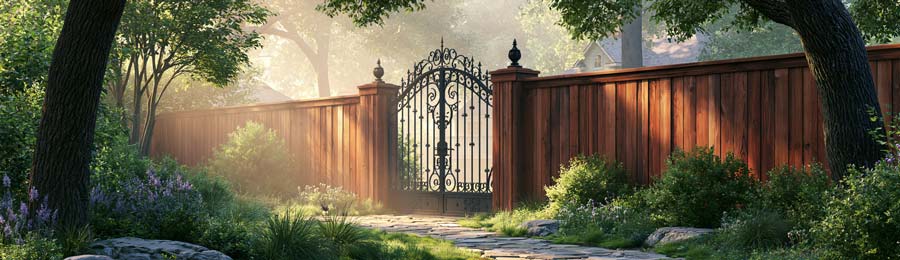
In Plano’s HOA communities, the most common custom gate situation is not a straightforward replacement or a standalone installation. It is the side yard gate that sits at the transition between an ornamental iron front perimeter and a cedar privacy fence in the rear — visible from the street, governed by HOA design requirements that apply to the iron side, and functional for daily use on the cedar side. That gate cannot be a stock panel pulled from a catalog. It has to be fabricated to fit the exact opening, match or complement the iron specification that the covenant requires at the street-facing exposure, and integrate with the cedar fence system behind it without looking like two different contractors built two different things.
That transition point is where most Plano custom gate projects begin. Before the material selection, before the sizing discussion, before the hardware conversation — the HOA covenant gets read. The design approval process for gates visible from the street in Plano’s deed-restricted communities typically requires a submission covering gate material, height, finish, and setback. We prepare that documentation as part of every project and advise on what architectural review committees in Plano’s communities expect to see before they grant approval.
Where Custom Gates Make Sense in Plano
Three situations consistently call for custom fabrication in Plano’s market. The first is the two-material transition: an opening that sits between iron and cedar where neither a standard iron panel nor a standard cedar gate reads as intentional. The second is a non-standard opening width — driveways and side yard passages in Plano’s established neighborhoods were not built to stock gate dimensions, and a gate that does not fit the opening correctly creates alignment, swing, and hardware problems that compound over time. The third is an HOA specification that requires a specific profile, height, or finish that stock panels do not offer. In all three cases, fabrication to the actual opening and the actual covenant requirement is the only path to a gate that works correctly and passes HOA review.
Where the Iron Fence Ends and the Cedar Begins
Fabrication, Automation, and What the Process Looks Like in Plano
Wood Gates, Iron Gates, and Combination Frame Construction
Custom wood gates in Plano are almost always cedar — the same Western Red Cedar that frames the privacy fence they attach to, stained to match the existing fence color or pre-stained at installation. Cedar gates are framed with a welded steel internal frame rather than wood-only construction for driveways and wider openings where a wood-only frame would rack over time under its own weight.
The steel frame carries the structural load; the cedar cladding provides the visual match to the fence. For side yard pedestrian gates that match an ornamental iron front fence, fabrication in mild steel with the same powder-coat finish as the fence panels produces a gate that reads as part of the same system rather than an add-on. Combination frame gates — a steel structural frame with cedar or composite infill — are the correct specification for openings where the gate needs to satisfy both the HOA’s front-yard iron requirement at the hinge post and the cedar privacy aesthetic at the latch side.
Building Automation Compatibility In at Fabrication
Plano’s freeze seasons have taught a specific lesson about gate automation: retrofitting an operator onto a gate that was not built for it costs significantly more than specifying automation compatibility at the time of fabrication. The post sizing, hinge placement, gate weight, and swing arc that work for a manually operated gate are not always the same specifications that work for an automated one. A gate built with an undersized hinge post, a weight distribution that exceeds the operator’s rating, or a swing arc that conflicts with the operator arm placement will either fail mechanically or require partial rebuilding before automation can be added.
If there is any possibility that a gate will be automated in the future, we specify it for automation at fabrication — heavier hinge posts, correct weight distribution, operator mounting provisions built into the frame. The cost difference at fabrication is modest. The cost of rebuilding after the fact is not. Automatic driveway gate installation covers operator selection and access control options for gates being automated at the time of installation.
Gate Hardware for North Texas Conditions
Hardware selection on a custom gate determines how the gate performs five and ten years after installation. In Plano’s climate — UV exposure, temperature cycling, occasional freeze events — hardware that is not specified for exterior conditions fails predictably.
Hinges should be heavy-duty stainless steel or hot-dip galvanized steel, not zinc-cast hardware that corrodes within two to three years of installation. Latches and locks should be stainless or brass. Gate closers should be oil-filled enclosed-spring units rather than exposed spring mechanisms that degrade under UV exposure. For cedar gates, ring-shank galvanized nails or stainless exterior screws — not staples — at every fastening point. We specify hardware to the gate’s weight, use frequency, and exposure conditions on every project.
Common Questions About Custom Gates in Plano
Can you build a gate that matches my ornamental iron fence on one side and my cedar fence on the other?
Yes — this is one of the most common custom gate requests in Plano’s HOA communities. The transition gate between an iron front perimeter and a cedar rear privacy fence requires a combination approach: a steel structural frame fabricated and powder-coated to match the iron fence specification, with cedar infill or cladding on the interior face that reads as part of the cedar fence system from the backyard side. The result is a gate that satisfies the HOA’s front-yard iron requirement from the street and integrates visually with the cedar fence from inside the property. We fabricate these to the exact opening dimensions and to the HOA’s material and finish specification.
Does my Plano HOA need to approve a custom gate design before installation?
For gates that are visible from the street or installed along a shared property line, most Plano HOA architectural review committees require a design submission before installation can proceed. The submission typically covers gate material, height, finish color, and setback from the sidewalk or street. Approval timelines vary by community — some committees meet monthly, others have faster review cycles. We prepare the standard documentation that Plano HOA architectural review committees require and advise on what the approval process looks like for your specific community before any fabrication is scheduled.
Should I have my custom gate built automation-ready even if I am not automating it now?
In most cases, yes. The cost of specifying a gate for future automation at the time of fabrication — heavier hinge posts, correct weight distribution, operator mounting provisions in the frame — is modest compared to the cost of rebuilding a gate that was not specified for automation when an operator is added later. In Plano’s climate, where freeze-season gate failures frequently prompt homeowners to reconsider manual gates, building automation compatibility in from the start is a practical decision even for homeowners who have no immediate automation plans.
How wide should a custom driveway or side yard gate be?
Pedestrian side yard gates are typically 36 to 48 inches wide — wide enough for standard foot traffic, lawn equipment, and wheelbarrows. Vehicle access gates for riding mowers or utility vehicles should be at least 60 to 72 inches. Driveway gates for passenger vehicles are typically 10 to 16 feet total width for a dual gate, or 8 to 10 feet for a single swing configuration where the driveway width allows it. The correct width is determined by measuring the actual opening and identifying the widest item that needs to pass through — which is frequently a lawn mower or outdoor furniture piece rather than a vehicle. We measure every opening during the estimate before any width is specified.
How much do custom gates cost in Plano?
Custom cedar pedestrian gates typically run $500 to $1,500 depending on width, frame construction, and hardware specification. Custom iron or steel gates for residential applications run $800 to $3,000 for pedestrian sizes. Driveway gates — single or dual panel, wood or iron — run $1,500 to $5,000 for manually operated installations depending on width, material, and fabrication complexity. Combination frame gates with cedar infill on a steel structural frame run toward the higher end of the range for their size category. Automation adds cost depending on operator selection and access control configuration. Every estimate is free, starts with a measurement of the actual opening and a review of HOA requirements, and produces a written specification before any fabrication begins.